Hear from Sligo Scholars, in their own words, about their time at the Yeats International Summer School.
Terrible Beauty, Sacred Witness
by Nancy Gonzalez St. Clair, 2026 Sligo Scholar
The experience of taking part in the Yeats International Summer School has shown me that it is not enough merely to read a poet; we have to go into the landscapes and environments which inspired him. As a result of the lectures, seminars, discussions and excursions, I started to sense Ireland coming through in Yeats’s words: its myths and acts of uprising, its lovely fields and its hidden wounds. His poems grew to be more than poems; they became rooms in which a nation could grieve, remember and consider what it might still become.
Yeats was aware that art and politics have the same troubled heritage. He turned to Irish folklore since empire does not conquer merely territory but also attempts to conquer memory. In “Easter, 1916,” he declines the comfort of certainty and stands caught between reverence and horror, between the dream of freedom and the fact of bodies being sacrificed for it. To me, “A terrible beauty is born” sounds at the same time like a blessing and a warning: although history may transform us, such transformation always requires that some people should pay the price.
I have come to understand Yeats’s devotion to mysticism: the gyres, spirits, visions, and invisible forces turning underneath the surface of human history. Perhaps the unseen and the spiritual were his way of naming what reason alone might never contain. As he aged, his poetry grew more somber, sharper, and more distilled, as if time taught him to strip away every unnecessary word. His life reminds me that a poet’s voice changes because the poet has endured enough to understand that pain need not have the final word; it can be transformed as art which outlives the wound.
I can see my own experience reflected in that transformation. Like Yeats, I have drawn from the trauma lodged in the deepest interior of my soul. I create poetry not because suffering is beautiful, but because the human spirit has the ability to transform its wounds into something meaningful and enduring. My poetry is about my Mexican culture, politics, women, and the territories of memory. My earliest teachers were family members who kept stories in their mouths and sacrifice in their bodies. They passed on invaluable traditions. These inheritances include the protest found in the corridos, the spirits that return on Día de los Muertos, and healing practices of the curandera. Whenever I sit down at the page, I am not working by myself; my indigenous ancestors come close, whispering. It is my hope that my poetry grows into a small flame held in the darkness, and within its light, the forgotten find their way home.
The Yeats Summer School has deepened my love for the poetry of witness, the kind of poetry that asks more of us than simply looking at suffering. To witness is to refuse the history power places in our hands and calls truth. It is to lift buried testimony into the light, even when that light trembles. A poem cannot unmask the men who come with guns and the authority of the state. It cannot reverse violence or restore the lives pushed to the margins by hatred. But it can name what happened. What is still happening. It can break the silence that power needs in order to survive. Language enters the page like a wound. It leaves behind the presence of someone who lived and whose absence must never be mistaken for erasure. When one person bears witness, another may find the courage to look more closely and speak. The poem becomes a living archive. It breathes through the wound and remembers what the world would rather forget. Long after the final line, the poem continues to ask us to listen. Perhaps all poetry of witness begins in the place Yeats finally returned to:
“I must lie down where all the ladders start
In the foul rag and bone shop of the heart.”
Joslynn Howard on Studying Poetry in Ireland
“The value of studying abroad is getting to experience different cultures and having the ability to meet new people that you otherwise would not get to meet in America. At the International Summer School, there were people from all over the world, and going into it, I didn’t know that was going to be the case. It was such a surprise and really interesting. I think that’s the best part about studying abroad…
I actually got to do a poetry workshop with Leontia Flynn, a well-known Irish poet from Belfast. That was really interesting because I had never done a poetry workshop with someone so experienced. Hearing everyone’s different perspectives—not just my peers my own age but also input from people much older than me—was really valuable.”
Outstanding Student: Eric Orosco
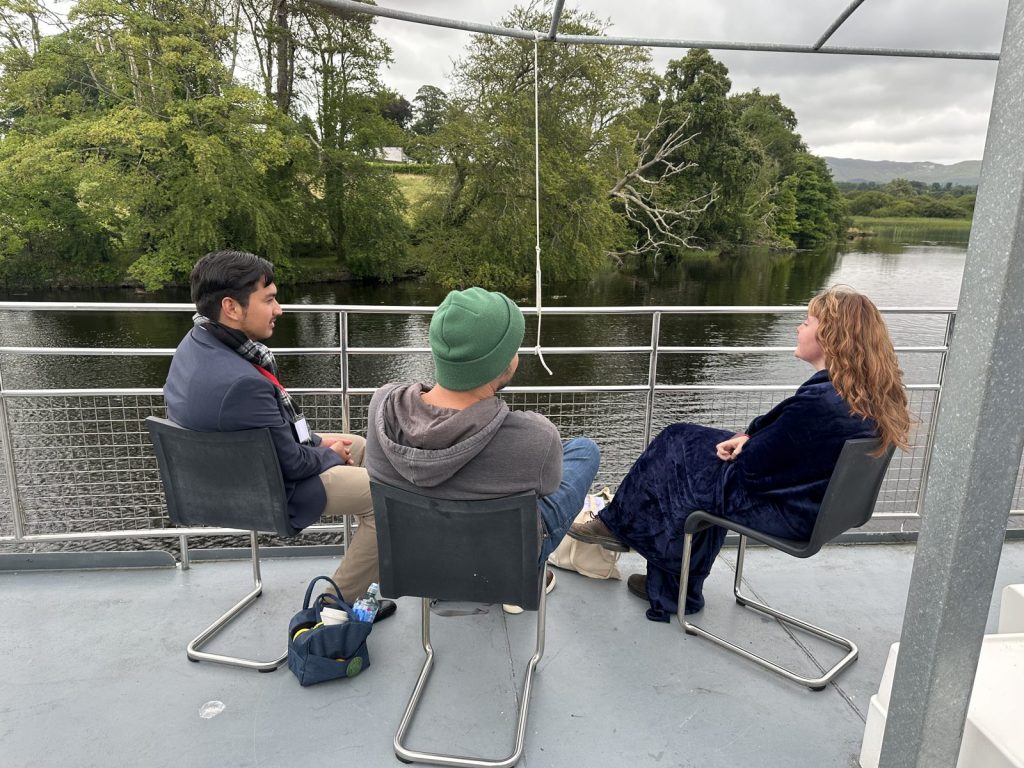
“One of the most incredible aspects of the fellowship was experiencing firsthand the locations Yeats referenced in his poetry. For example, we took a beautiful ferry ride over Lough Gill, where the Lake Isle of Innisfree is located. As we floated across the water, we read “The Lake Isle of Innisfree” aloud and gazed at the landscape Yeats likely had in mind while writing it. This kind of immersive experience made the fellowship truly special, as it allowed us to connect directly with the settings that inspired some of Yeats’ greatest works.”
Read more: English student says studying in Ireland “changed my life” (College of the Pacific, 2017)
Angel Zhong: Writing Poetry in Yeats Country
“I wrote 10 poems, I think, which is insane for me as someone who has been a very intermittent writer.”
“Just knowing that we were literally traversing the space of the poem that’s written about this place…”
Guiying (Angel) Zhong, 2020 Sligo Scholar, University of the Pacific
Read more: Study abroad in Ireland program inspires English major to write poetry, reflect on identity (University of the Pacific, 2022)
A Season in Sligo at the Yeats International Summer School
by Meaghan Allen, 2017 Sligo Scholar
“When I first applied to the Yeats International Summer School (YISS) scholarship, I did not know what the YISS was or that it even existed. I Googled the program and its website, but even after hours of exploring the website – reading through FAQs, biographical snapshots of lecturers, and one YISS program from the 1970s – I still felt a bit vague about what the program actually is or does. All I could truly gather was that, due to the school’s name and its affiliation with the Yeats Society, anything and everything regarding the Irish poet W.B. Yeats would be fair game for the ten-day summer school. Having just completed Professor Eric Falci’s Irish Literature course at UC Berkeley in the spring, which was a wonderful – if at times overwhelming – wellspring of knowledge about Ireland including Ireland’s history and its trauma, Irish literature, Irish traditions, etc., I believed I knew enough about Ireland to understand and appreciate the small details or insights the Yeats International Summer School had to offer.” (read more)
Sligo Scholars on Video
Created by Tuleburg Press and WordsOutspoken.
In the News
- English student says studying in Ireland “changed my life” College of the Pacific, 2017
- A Season in Sligo at the Yeats International Summer School The Wheeler Column, UC Berkeley, 2017
- Study abroad in Ireland program inspires English major to write poetry, reflect on identity University of the Pacific, 2022

